Tech Stack
Spring Boot
Java
HTML 5
Description
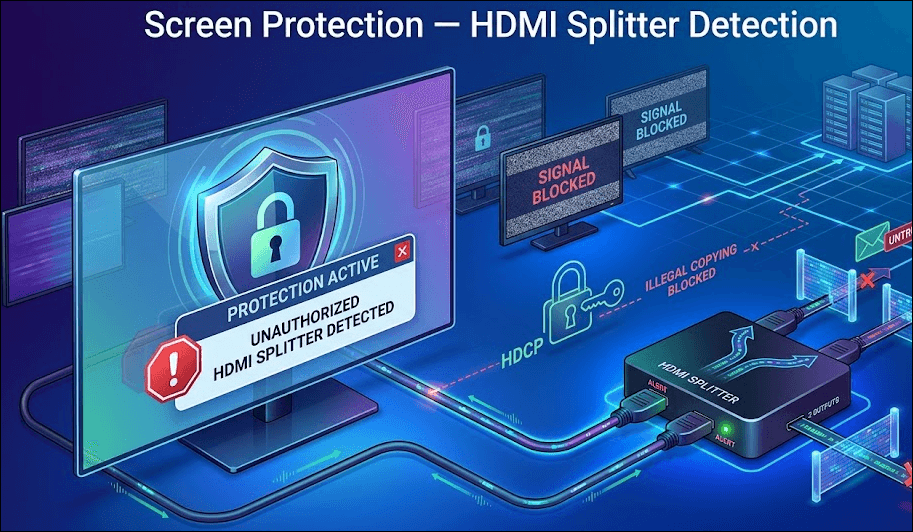
This Spring Boot REST API serves as a high-security Display Integrity & Content Protection Service. It is designed to prevent content piracy and unauthorized screen recording by identifying hardware-level bypasses like HDMI 'strippers' or unauthorized capture cards.
Core Mechanism: Multi-Layer Signal Analysis
The system moves beyond simple software checks by analyzing the physical and cryptographic properties of the display chain:
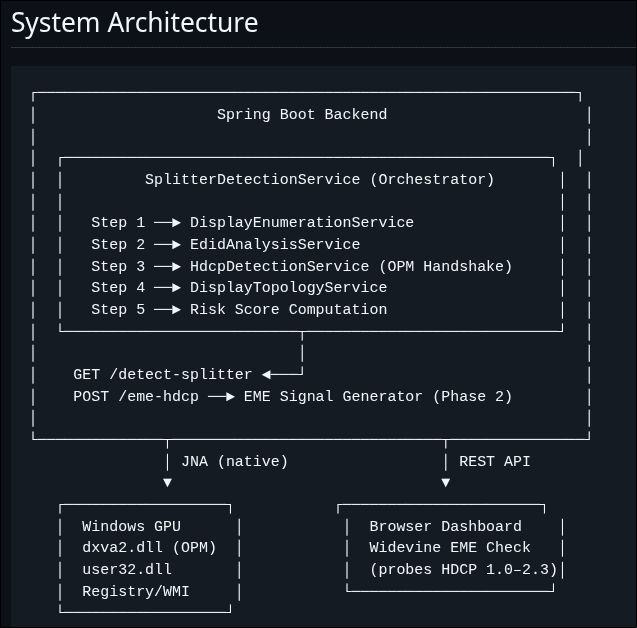
- EDID Fingerprinting: Extracts the Extended Display Identification Data to verify the display's 'birth certificate.' It checks for manufacturer inconsistencies or generic IDs common in 'ghost' display emulators and splitters.
- OPM & HDCP Handshake: Executes a full Output Protection Manager (OPM) cryptographic challenge. By forcing a hardware-level HDCP (High-bandwidth Digital Content Protection) handshake, the API can detect if the encryption is being terminated early or 'stripped' by a middleman device.
- Display Topology Analysis: Maps the connection tree. It detects if a single signal is being mirrored or split across multiple downstream sinks (topology 'branching'), which is a hallmark of unauthorized redistribution.
- Widevine DRM Probing: Uses browser-level hooks to check for Widevine L1/L3 security levels. If a hardware device degrades the DRM path to a lower security level, it signals a compromised environment.
Page Info
Technology Stack
Spring Boot 3.x (Java), JNI (Java Native Interface) to call low-level Windows/Linux display APIs, OPM (Output Protection Manager) & DXGI (DirectX Graphics Infrastructure), RESTful Endpoints with WebSocket support for real-time probing
Architecture